



The kitchen remodel of 2027 is planned, not just opened up. Designers are zoning kitchens with partial walls, sliding partitions and a second prep space instead of taking out every wall. Cabinets are going to natural wood, white oak first, with the appliances hidden behind matching panels. Quartzite has passed quartz as the favorite countertop. Induction is the cooking product architects see growing fastest. And the pantry has become a working room, with its own counter, a coffee station and a home for the small appliances. Those are the headline findings of the National Kitchen & Bath Association's 2027 Kitchen Trends Report, released October 14, 2026 from a survey of 830 kitchen professionals, and they are what our designers are drawing in San Diego right now.
San Diego adds three things no national list covers. A tariff calendar: imported cabinets carry a 25% duty that is scheduled to double on January 1, 2027, imported quartz has carried a new one since August 2026, and most imported appliances are taxed on their full value. A California rule in the making that could take high-silica engineered stone off the table altogether. And our own records, which say something the trend reports do not: here, the kitchen is rarely remodeled alone. This guide puts the national research, the California rules and our San Diego data in one place, with what each choice does to a budget. Every figure is from a named trade or government source read in November 2026, or from our own records, published as shares rather than counts.
What the 2027 research says
The NKBA's 2027 Kitchen Trends Report asks designers, dealers, remodelers and architects what they expect to be designing over the next three years; 62% of the 830 respondents are designers and nine in ten work in the United States. Its summary line is the best one-sentence description of where kitchens are going: design is "shifting from simply adding more to making every decision count." The share of designers who expect kitchens to keep getting bigger fell from 76% in the 2026 report to 52% in this one. What is growing instead is everything around the kitchen: 94% expect attached mudrooms to be popular, 88% say the pantry is turning into a working extension of the kitchen, and 90% expect a dedicated beverage area.
The American Institute of Architects' most recent kitchen survey, published in March 2026, points the same way from a different group of professionals. Residential architects name working and prep pantries the most popular kitchen feature and induction cooking the most popular kitchen product, with more and larger windows, outdoor kitchens and coffee bars close behind. Two findings in it are worth as much as the winners: smart appliances fell from a net 15% of architects reporting rising interest to about 6%, and steam ovens went slightly negative. The 2027 kitchen is better planned, not more connected.
Layout: zones, not one big room
This is the reversal in the 2027 report. A year ago the NKBA still listed the open layout as a growing trend. Now it says "defined zones, partial walls and operable partitions are now replacing the fully open floor plan," 81% of designers call intentional zoning here to stay, 46% see semi-enclosed layouts coming up, and 47% see dedicated prep spaces and back kitchens coming up. Designers also rank reconfiguring the layout as the second-best return on a kitchen investment, behind only new cabinetry.
That does not mean the walls are going back up. Architects in the AIA survey still report more kitchens opening to the living space than a year earlier, and both things are true in the kitchens we build: the sightline stays open and the zones get defined. In practice that is a short return wall or a cased opening where the old wall stood, a two-sided fireplace or a run of cabinetry between the kitchen and the family room, pocket or sliding glass doors that close off the mess when guests arrive, and a prep space out of sight. In our own records, about one in five written kitchen inquiries asks to change the layout or move something, and about one in thirteen asks specifically to open or remove a wall.

In a San Diego house the layout decision is also the budget decision. Keep the plumbing and the walls where they are and a full remodel with mid-range finishes runs $100,000 to $150,000 in our 2026 pricing. Take out a load-bearing wall or move the sink in a slab-on-grade house and the project needs a structural engineer, a beam, plan check instead of a no-plan permit and three to four more weeks, which puts it in the $150,000 to $225,000 tier. The 2027 idea of a partial wall is good news for budgets: a kitchen that keeps part of its structure and gains a cased opening often gets the room people wanted from an open plan at a fraction of the engineering.
Cabinets: wood, hidden appliances, closed storage
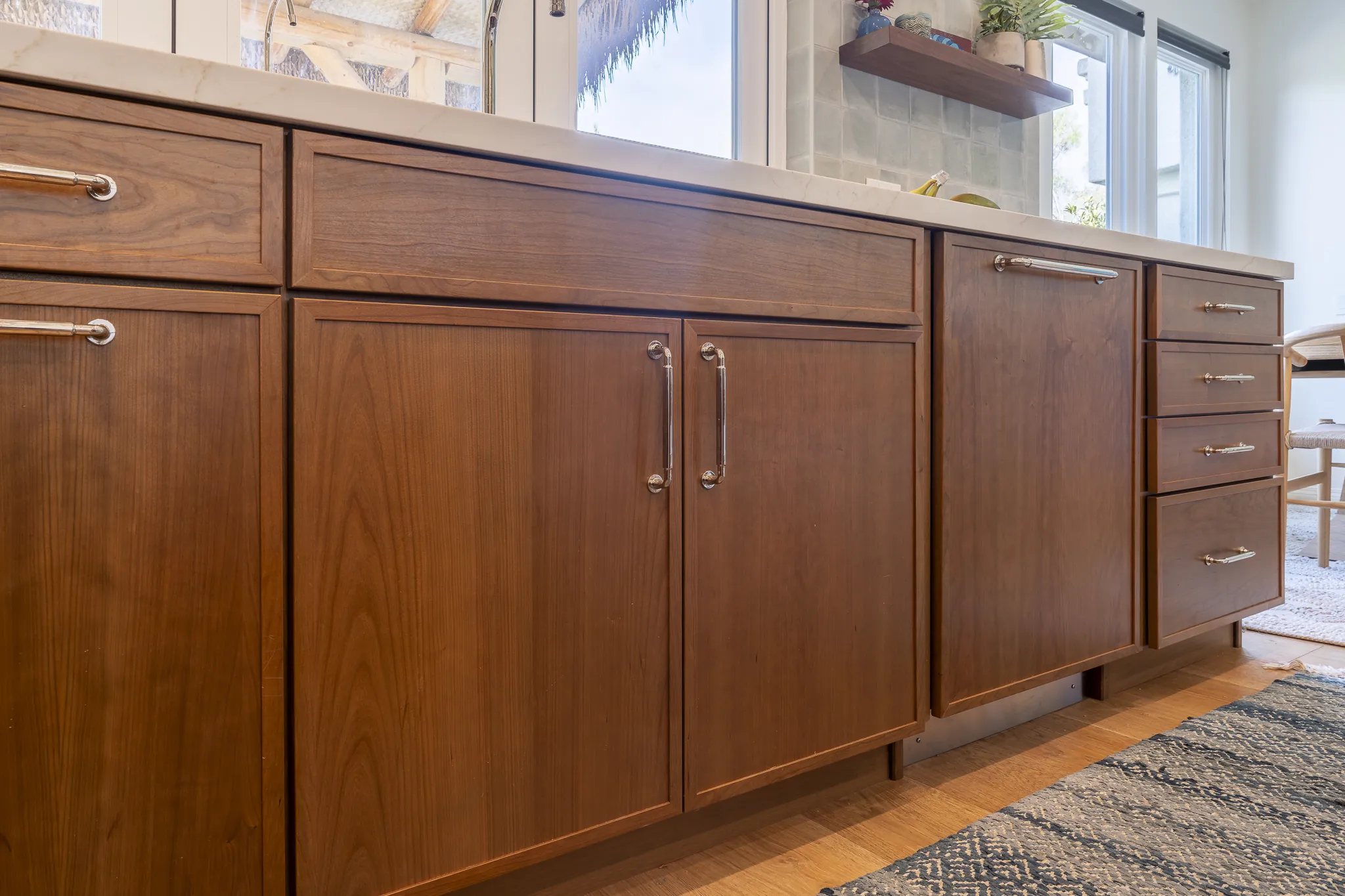
Cabinetry is where the 2027 kitchen looks most different from the white-and-gray kitchen of ten years ago. In the NKBA survey white oak is the wood of choice for 49% of designers, 34% expect natural, unfinished-look cabinets to be popular, and light and medium wood tones tie behind them. 85% agree that cabinetry is now designed to hide appliances and working parts, which means panels on the refrigerator and dishwasher, appliance garages with outlets inside and a microwave in a drawer. 64% say open shelving is on its way out in favor of doors. And 54% expect the island in a different color from the rest of the cabinets. Even the stain companies agree: Minwax's 2027 color of the year is Pickled Oak, a light wash that lets the grain show.

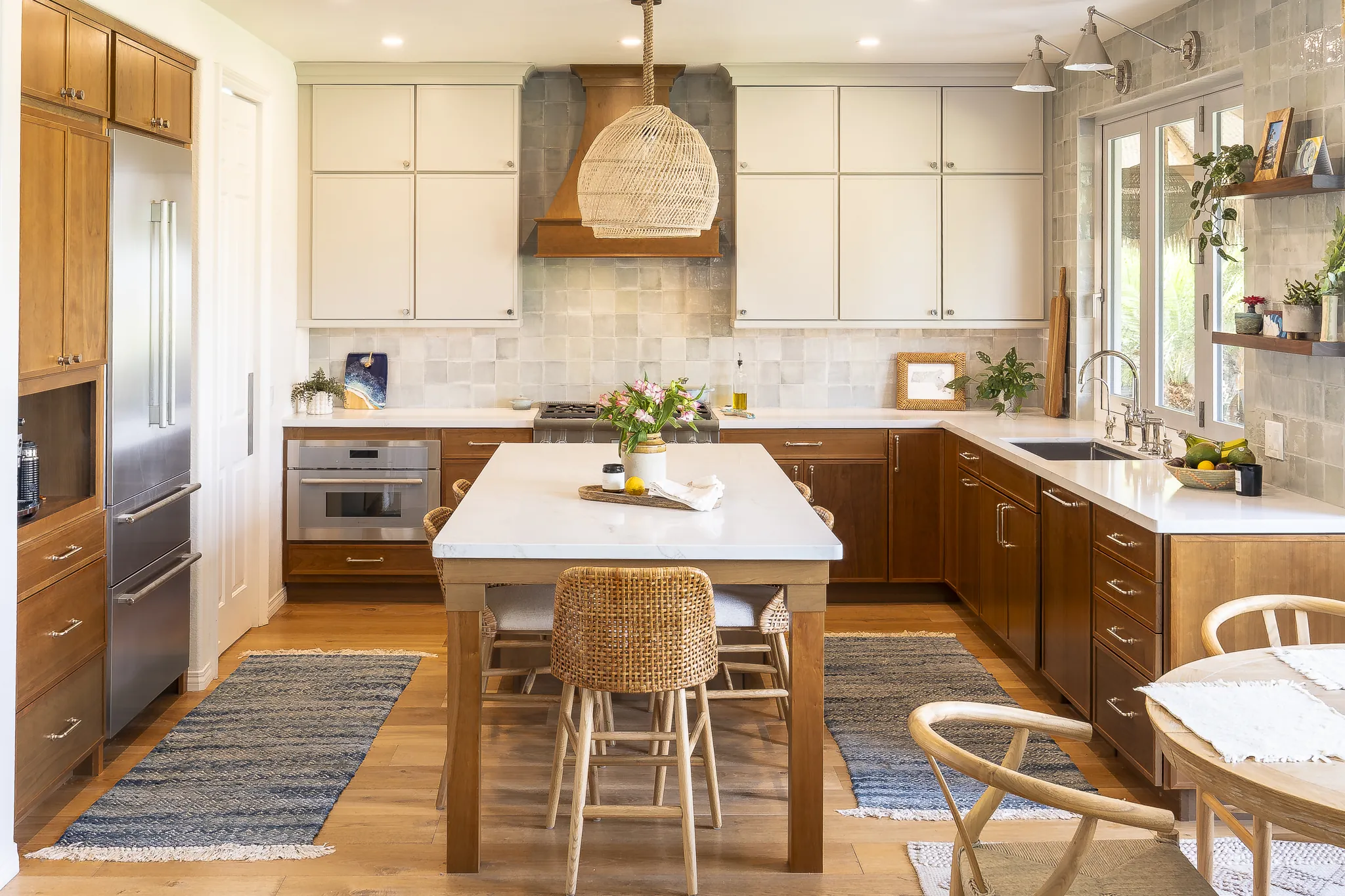
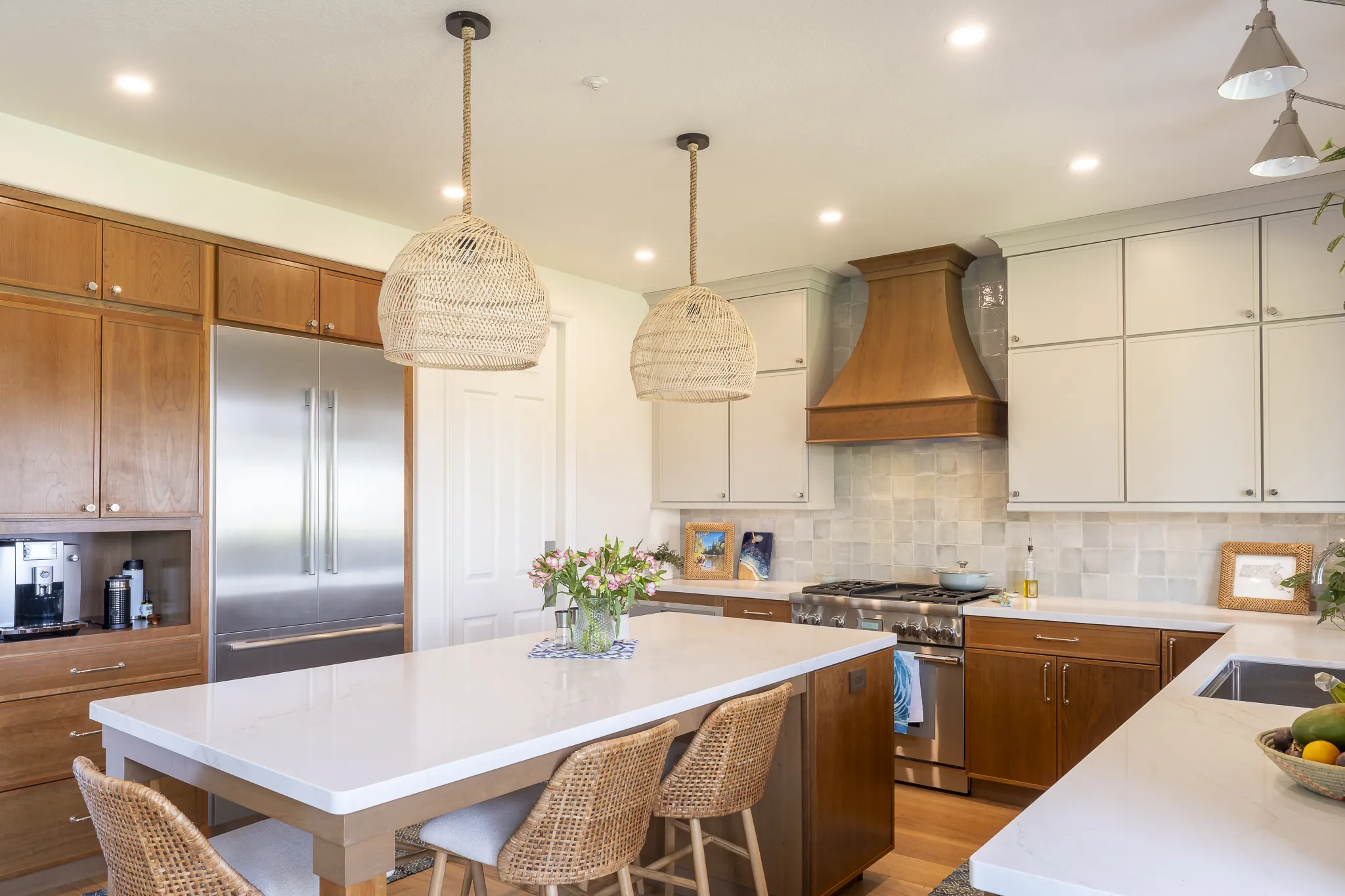
What we build most is the mixed kitchen: wood on the island or the base cabinets, a painted or white upper run so the room stays bright, and one tall wall of closed storage. Flat-panel and slim-rail doors have joined the shaker door rather than replacing it; in a 1970s ranch the shaker still looks right, and in a newer house the flat panel does.
The cabinet line is also the part of a 2027 kitchen most exposed to Washington. Imported kitchen cabinets and bathroom vanities have carried a 25% tariff since October 14, 2025, and under the proclamation of December 31, 2025 the rate is scheduled to rise to 50% on January 1, 2027, except for countries that reach an agreement. That step was postponed once, on the last day of 2025, so we write "scheduled" on purpose. Cabinetry is about a third of a kitchen budget, roughly $35,000 of a $125,000 remodel, so it is the line worth asking about: where is this cabinet line built, and is the price I am looking at before or after the duty? Domestic semi-custom lines now price much closer to imports than they did, and for many kitchens they are the better answer on lead time as well.
See what a 2027 kitchen costs in your house
A complimentary in-home design consultation is where these ideas meet your floor plan: a designer measures the kitchen, hears how you cook and comes back with a layout, a cabinet line and a range you can keep. If you want a first number tonight, the kitchen calculator uses our current pricing and takes about a minute.
Countertops and backsplash: quartzite passes quartz
In the 2027 report natural quartzite has moved ahead of engineered quartz as the designers' favorite countertop: 78% name it, against 74% for quartz. Nearly half, 48%, prefer a honed or matte finish to a polished one. Quartzite is a quarried stone, harder than marble and with the veining people want from marble; porcelain and sintered slabs are the other materials our designers are specifying more of, especially for full-height backsplashes and waterfall ends.
Taste is only part of why. Two rules are moving against engineered quartz at the same time:
- A new federal tariff. Since August 15, 2026, imported quartz surface products, countertops and backsplashes included, carry a four-year safeguard duty under a presidential proclamation of July 31, 2026: 25% within a quarterly import quota and 50% above it in the first year, on top of existing duties, stepping down slightly each August. Several countries are excluded. Granite, marble, soapstone and quartzite are outside its scope.
- A California safety rule in draft. Cutting engineered stone releases silica dust that has caused silicosis among fabrication workers. California banned dry cutting in 2025, and in May 2026 the state's workplace safety board asked Cal/OSHA to draft an emergency rule. The draft dated October 22, 2026 would prohibit fabricating, and installing, artificial stone with 1% or more crystalline silica. It has not been adopted and was not on the board's November agenda. Porcelain, sintered stone without binders and natural stone slabs are not artificial stone under the draft.
What that means for a kitchen being designed now: quartz is still legal, still available and still the mid-range standard, and we will keep installing it while the rules allow. But if you are choosing between a quartz and a quartzite or porcelain you like equally, 2027 is a year to lean toward the one that no pending rule touches. We will update this page when the board acts.
On the wall, the two directions are a slab backsplash in the same stone as the counter, with no grout to clean, and handmade-look tile in soft whites and creams that gives a wood kitchen texture without pattern. Both replace the plain 3-by-6 subway tile.
Cooking and appliances: induction leads, artificial intelligence waits
Induction is the kitchen product architects report rising fastest, with a net 57% saying its popularity is increasing in the AIA's latest survey. The reasons are practical. The federal ENERGY STAR program puts induction at about 85% of its energy delivered to the pan against roughly a third for a gas burner, and boiling at nearly half the time. The room stays cooler, the glass wipes clean, and there is no open flame at a child's height.
California's code leans the same way without forcing the choice. Three facts are worth knowing before you pick a range:
- A remodel does not have to be wired for electric cooking. The 2025 Energy Code requires new homes built with a gas range to include a 240-volt, 50-amp circuit for a future electric one, but the Energy Commission's compliance manual is explicit that there are no electric-ready requirements for additions or alterations. We run that circuit anyway while the wall is open, because adding it later means opening the wall again.
- A gas range needs a stronger hood. In the code's table for a home over 1,500 square feet, a hood over a gas range must move 180 cubic feet of air per minute, or meet a higher capture rating, and a hood over an electric or induction range 110. When a hood is replaced in a remodel it has to at least match the airflow the house was permitted with, or 100 cubic feet per minute, whichever is greater, and a recirculating hood does not count as ventilation.
- The incentives are gone. The federal tax credit for efficient home improvements ended with work completed after December 31, 2025, and California's federally funded rebates for single-family homes were fully reserved by February 2026. We found no open rebate or credit for an induction range in a San Diego single-family remodel as of November 2026. Induction has to earn its place on cooking alone, and in our kitchens it does.
One number from our own records explains why induction is a designer's recommendation more often than a client's request: among the written kitchen inquiries we have on file, about one in a thousand mentions induction by name. People ask for cabinets, counters and a better layout. The cooktop conversation happens at the design table, and it usually starts with the electrical panel, because many San Diego houses built before 1980 still have 100-amp service that cannot carry an induction range, an air conditioner and a car charger together.
The other appliance trends are quieter. Panel-ready and built-in appliances are up in both surveys, which fits the hidden-kitchen idea. Air fryer ovens are expected to out-draw plain convection, 57% to 46%. And the smart kitchen is the one prediction of the last decade that designers are walking back: only 27% expect ovens with food-recognition artificial intelligence to be wanted in 2027, and 24% expect AI that learns how you cook. What people do want from technology is protection: 65% of designers expect leak detection with automatic shut-off valves, and 57% expect phone alerts for a power failure or a gas leak. On budget, a standard appliance package runs $10,000 to $15,000 in our pricing; panel-ready refrigeration, column units or a 48-inch range can push it past $40,000, and since April 2026 most imported major appliances carry a 25% tariff on their full value.
The pantry, the beverage station and the back kitchen
If one room defines the 2027 kitchen it is the one beside it. 88% of designers in the NKBA survey say pantries are "evolving from storage into multi-functional extensions of the kitchen," 73% predict dedicated stations for small appliances, and 67% expect walk-in pantries to dominate. Beverage areas, at 90%, are the most widely expected feature in the whole report, up from 85% a year earlier. Architects agree: working pantries top the AIA's feature list, and in the National Association of Home Builders' buyer survey a walk-in pantry has been at or tied for the top kitchen feature in every edition, wanted by 80% of buyers in the latest one.

Most San Diego tract houses have no room for a scullery, and they do not need one. The same idea scales down to a pantry wall with rollouts and a counter inside, an appliance garage at counter height with its own outlets, or a coffee station recessed into a tall cabinet. The test is simple: can breakfast be made and cleaned up without anything living on the main counter. Where there is space, usually borrowed from a hallway, a laundry room or an oversized garage entry, a real working pantry with a second sink is the most-used ten square feet in the house. The same report has 94% of designers expecting mudrooms attached to the kitchen, 64% pet feeding stations and 63% eat-in kitchens, which in our projects is most often a built-in banquette.
Light, air and water
84% of designers expect kitchens with multiple layers of light, and the fixtures they name tell you what the layers are: under-cabinet lighting (87%), lighting inside cabinets (76%), recessed lights (57%), low path lighting for the night (52%) and, well down the list, pendants (46%). The single row of can lights is the thing being replaced.
California's code happens to require the same structure. In a remodel, any new or altered lighting has to be high efficacy, lighting in a kitchen has to be on a dimmer, and under-cabinet, under-shelf and display-cabinet lighting has to be switched separately from the ceiling lights. The layers designers want are the layers the code puts on their own switches, so a well-lit 2027 kitchen costs a few more dimmers, not a variance.
The report also treats ventilation, water filtration, touchless faucets and sound-absorbing materials as health features rather than extras; the NKBA's phrase is that designers are "positioning ventilation as a health feature rather than a code requirement." Drinking-water filtration is wanted by three quarters of buyers in the home builders' survey. In a San Diego kitchen that means a ducted hood sized to the range, a filtered tap or a whole-house system specified with the plumbing, and, in an open plan, a quiet dishwasher and soft surfaces somewhere in the room.
Color: neutrals first, then green
Neutrals remain the designers' first answer at 96%. Greens follow at 83% and blues at 75%, each a few points lower than a year ago, with reds and burgundies steady at 47%. The paint companies have settled the question of which color for now: of the eight 2027 colors of the year announced by early November 2026, four are greens or close to it.
| Brand | Color | What it is |
|---|---|---|
| Benjamin Moore | Webster Green HC-130 | A mid-tone traditional green |
| Sherwin-Williams and HGTV Home | Celery SW 6421 | A soft, muted green with yellow undertones |
| Behr | Grounded T27-01 | An earthy olive between olive and moss |
| Glidden | Artifact PPG10-16 | A calm aqua |
| Valspar | Cottage Door 8004-38E | A grayed, warm blue |
| Dunn-Edwards | French Press Coffee DEBN07 | A deep brown with a plum undertone |
| Dutch Boy | Deep Rooted 311-7DB | A rich, earthy orange |
| Minwax (stain) | Pickled Oak MW260 | A light wash that shows the grain |
Pantone names its color in December. In a kitchen these colors go where they are easy to change: a painted island, the lower cabinets, the walls and the pantry interior. The permanent surfaces, the stone, the wood and the floor, stay in the warm neutral range that 96% represents, which is how a green kitchen built in 2027 still looks right in 2040.
The San Diego line on every list: open it to the yard
National reports rank windows and outdoor kitchens among rising features; architects put more and larger windows second on their kitchen list and outdoor kitchens third. In San Diego this is not a trend so much as the point of the room. About one in five of the written kitchen inquiries in our records mentions windows or doors, and one in nine mentions the patio, deck or yard in the same breath as the kitchen. The moves are a pass-through window with a counter outside, a slider or folding door in place of the breakfast-nook window, and the grill and outdoor counter planned on the same drawing as the kitchen so the gas, the power and the traffic all line up.
What our records add: the kitchen is rarely remodeled alone
Trend reports treat the kitchen as a room. Homeowners do not. When we read the written kitchen inquiries in our records, the most common thing named beside the kitchen is another room.
Three things follow for anyone planning a 2027 kitchen. Flooring is the hidden scope: a kitchen floor rarely stops at the kitchen, and deciding how far it runs is a design decision, not a detail. The bathroom question is worth asking on day one, because one design phase, one permit and one crew for a kitchen and a bathroom costs less than two projects a year apart. And the national finding that designers expect value from reconfiguring the layout matches what people ask us for: more of them write about moving things than about any single finish.
Remodeled kitchen designs from San Diego homes
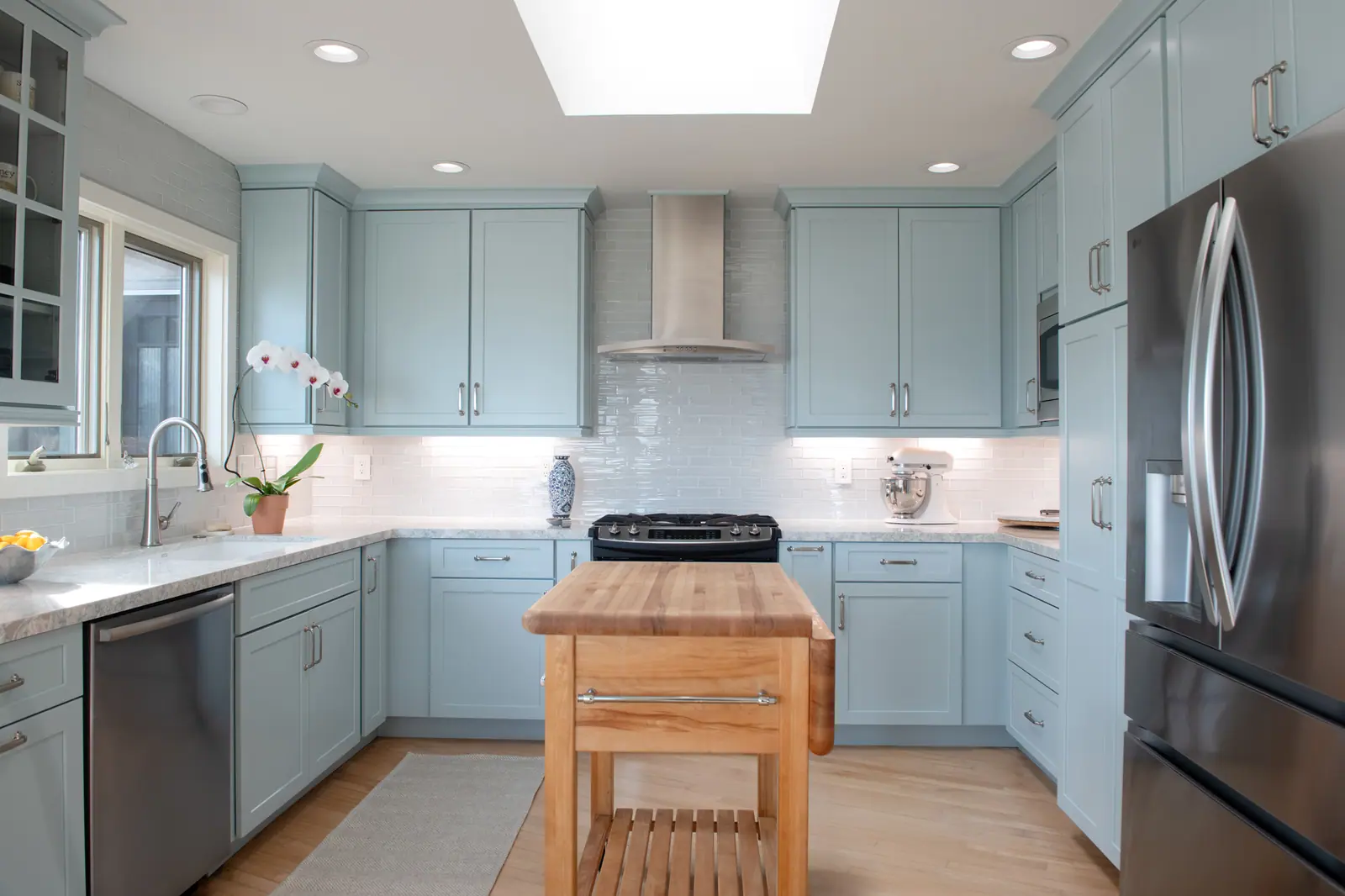
Four more kitchens we designed and built, each showing a 2027 idea in a real San Diego house. Every photo links to the full project.


What each 2027 choice does to a San Diego kitchen budget
A trend is only useful with a price beside it. These are the ranges from our San Diego kitchen cost guide, which carries the full breakdown, the permit paths and the history since 2021. Each is a complete, permitted project designed and built by one team.
| The choice | What it involves | What it does to the budget |
|---|---|---|
| Keep the layout | New cabinetry, counters, appliances, lighting and flooring; plumbing and walls stay | $100,000 to $150,000 with mid-range finishes; a no-plan permit that can issue in days |
| Re-zone or open the layout | A wall removed or moved, a sink or range relocated, engineering and plan check | $150,000 to $225,000; three to four more weeks of construction |
| Wood or custom cabinetry | About a third of the budget; the line and its origin matter more than the door style | About $35,000 of a $125,000 kitchen; semi-custom to custom can swing $20,000; imported lines face a 25% tariff, 50% from January 1, 2027 as scheduled |
| Quartzite, porcelain or a slab backsplash | More fabrication and more material than standard quartz with tile | Priced by the slab during design; imported quartz now carries its own tariff |
| Induction and hidden appliances | A 240-volt circuit, sometimes a panel upgrade; panels on the refrigerator and dishwasher | $10,000 to $15,000 for a standard package; past $40,000 for column and panel-ready units |
| A working pantry or beverage station | Cabinetry, a counter, outlets and often a second sink | Part of the cabinetry line when it stays inside the kitchen; a layout change when it borrows from another room |
| A refresh instead | Counters, backsplash, paint, hardware and lighting; cabinets and layout stay | From $60,000 |
Download the one-page 2027 kitchen trends summary (PDF)
Will it cost more in 2027 than in 2026? The evidence says yes, modestly and for specific reasons. Harvard's Joint Center for Housing Studies expects national remodeling spending to stay flat at about $525 billion through late 2027, and the NKBA says industry spending is "increasingly being supported by higher prices rather than stronger project activity." Building material prices were up 5.5% in the year to September 2026, the fastest since 2022; builders report labor costs up about 4%; the City of San Diego's plan check and inspection fees are about 7% higher than a year ago; and the cabinet, quartz and appliance tariffs all sit on the largest lines in a kitchen. A flat market is not a cheaper one.
What is on its way out
The fully open plan is giving way to open sightlines with defined zones, a place to hide the mess and doors that can close.
64% of designers say it is on its way out. A shelf or two for display survives; the dishes go back behind doors.
The wall of stainless steel is being paneled, garaged and built in. The range and the hood are the two pieces still meant to be seen.
The share of designers expecting larger kitchens fell from 76% to 52% in a year. Space is going to the pantry and the mudroom instead.
Wi-Fi refrigerators and AI ovens are wanted by a minority. Leak detection and a quiet, well-ducted hood are wanted by most.
Still a good counter, no longer the automatic one, with quartzite ahead in the survey, a new tariff and a California rule pending.
What our designers are drawing
Anastasia Berta, a Certified Kitchen and Bath Designer on our team, reviewed this guide. Her kitchens for 2027 start with where things go rather than what they look like.
The build side of the company reads the same report for a different reason: nearly every 2027 trend is a long-lead item.
Planning a 2027 kitchen: how long it takes
A San Diego kitchen runs four to eight months from the first design meeting to the final walkthrough. The four parts overlap less than people hope, which is why a kitchen meant for next summer starts this winter.
For the trends beyond the kitchen, from outdoor rooms to the wildfire and energy rules that take effect in 2027, see our San Diego home remodeling trends guide for 2027. If cabinets are your main question, our kitchen cabinet trends for 2027 article goes wood by wood and door by door, our kitchen design trends from 2023 show how far the room has moved, and the kitchen remodeling page shows how we design and build them.
How we built this guide
The trade figures come from the NKBA 2027 Kitchen Trends Report press release and abstract (the full report is for members; where it publishes no public number, we print none), the AIA Home Design Trends Survey for the first quarter of 2026 (its figures are read from published charts and rounded), the National Association of Home Builders' buyer survey, and the paint and stain companies' own announcements. The rules come from the Federal Register, the California Energy Commission's 2025 Energy Code manuals and the Cal/OSHA rulemaking page, each read in November 2026. Two of them can change on short notice, the cabinet tariff step and the engineered-stone rule, and this page will be updated when they do. The first-party figures are the written kitchen inquiries and the typed kitchen proposals in our records, published as shares; the counts stay with us. Prices are our 2026 pricing from the kitchen cost guide. We publish a new edition each year when the NKBA report comes out, and update this one when a rule changes.
Sources read for this guide (November 2026)
- National Kitchen & Bath Association, NKBA 2027 Kitchen Trends Report: press release "NKBA 2027 Kitchen Trends Report Signals Shifts in Kitchen Design" (October 14, 2026) and report abstract; 2026 Kitchen & Bath Industry Outlook, Mid-Year Update (July 21, 2026).
- American Institute of Architects, Home Design Trends Survey, Q1 2026: Kitchen and Bath (March 5, 2026).
- National Association of Home Builders, What Home Buyers Really Want, 2024 edition (Eye on Housing, September 10, 2024); building materials prices (October 15, 2026) and labor (October 14, 2026).
- Federal Register: Proclamation 10976 of September 29, 2025 and Proclamation 11000 of December 31, 2025 (timber, lumber, kitchen cabinets and vanities); Proclamation 11051 of July 31, 2026 (quartz surface products); Proclamation 11021 of April 2, 2026 (steel, aluminum and copper derivative articles, including household appliances).
- California Energy Commission, 2025 Building Energy Efficiency Standards: Single-Family Residential Compliance Manual (June 2025), sections 150.0(k), 150.0(o), 150.0(u) and 150.2(b); residential lighting FAQs.
- California Department of Industrial Relations, Cal/OSHA silica rulemaking page: discussion draft of October 22, 2026; Occupational Safety and Health Standards Board, Petition 609 decision (May 21, 2026); Senate Bill 20 (2025).
- U.S. Environmental Protection Agency, ENERGY STAR electric cooking products; Internal Revenue Service, Energy Efficient Home Improvement Credit; TECH Clean California, HEEHRA rebate status.
- Benjamin Moore, Sherwin-Williams, Behr, Glidden, Valspar, Dunn-Edwards, Dutch Boy and Minwax, 2027 color of the year announcements (August to October 2026).
- Joint Center for Housing Studies of Harvard University, Leading Indicator of Remodeling Activity (October 22, 2026); City of San Diego, Information Bulletin 501 (August 2026).
- Kaminskiy Design & Remodeling inquiry and proposal records (tools/blog_data/trends_2027.py; shares only) and 2026 kitchen pricing.
Kitchen remodeling trends 2027: your questions
Six, according to the NKBA's 2027 Kitchen Trends Report and the AIA's architect survey: zoned layouts with partial walls and prep spaces in place of the fully open plan; natural wood cabinetry, led by white oak, with appliances hidden behind panels; quartzite ahead of quartz on the counters, in honed finishes; induction cooking; pantries and beverage stations that work as a second kitchen; and layered lighting, with under-cabinet and in-cabinet light ahead of pendants. In San Diego, add a kitchen that opens to the yard.
The kitchen with no walls at all is. The NKBA's 2027 report says defined zones, partial walls and operable partitions are replacing the fully open floor plan, a reversal from its 2026 report, and 81% of designers call zoning here to stay. Architects still report kitchens opening to living spaces, so the practical answer is open sightlines with defined zones: a cased opening or short wall instead of a missing one, a pantry or back kitchen for the mess, and doors that can close. If your kitchen is already open, you do not need to rebuild a wall; you need a place to hide the work.
Quartz is not banned. As of November 2026 California has banned dry cutting of engineered stone, and Cal/OSHA has published a draft emergency rule, dated October 22, 2026, that would prohibit fabricating and installing artificial stone with 1% or more crystalline silica; it has not been adopted. Separately, imported quartz has carried a federal safeguard tariff since August 15, 2026. Designers in the NKBA's 2027 report now favor quartzite (78%) over quartz (74%). If you like a quartzite or a porcelain slab as much as a quartz, 2027 is a year to lean toward the material no pending rule touches.
Natural wood first: white oak is the wood of choice for 49% of designers in the NKBA's 2027 report, and light and medium wood tones follow. For paint, neutrals lead at 96% and greens follow at 83%; four of the eight 2027 colors of the year announced so far are greens, including Benjamin Moore's Webster Green and Sherwin-Williams' Celery. More than half of designers expect the island in a different color from the rest of the cabinets, which is the easiest place to use one.
No. California's 2025 Energy Code requires new homes built with a gas range to include a 240-volt circuit for a future electric one, but the Energy Commission's manual says there are no electric-ready requirements for additions or alterations, and no California rule bans gas ranges. What the code does change is ventilation: a hood over a gas range has to move more air than one over an electric or induction range. Most of our clients who cook on induction once do not go back; we run the 240-volt circuit in every kitchen so the choice stays open.
The evidence points to modestly more. Imported cabinets are scheduled to go from a 25% to a 50% tariff on January 1, 2027, imported quartz and most imported appliances already carry tariffs, building material prices were up 5.5% in the year to September 2026, builders report labor up about 4%, and San Diego's permit fees are about 7% higher than a year ago. Harvard expects national remodeling spending to stay flat through late 2027, but the NKBA notes that spending is being held up by higher prices rather than more projects. A flat market is not a cheaper one.
Four to eight months from the first design meeting to the final walkthrough: six to ten weeks of design and selections, ten to fourteen weeks for custom cabinetry, and eight to ten weeks of construction in the same layout or twelve to sixteen when a wall comes down. A same-layout kitchen usually qualifies for a no-plan permit that can issue in days; a structural change goes through plan check. A kitchen you want to cook in by summer 2027 should be in design by the start of the year.
Ready when you are